Stepping off the airplane at the main airport in Taoyuan, I was already anticipating the unmistakable scent in the air that would let me know that I had definitively arrived in Taiwan. I took some purposeful sniffs, smelled it, smiled… and realized how difficult it is to describe! I suppose it’s concrete amplified by humidity and freshened by the trees in the mountains at a visible distance. Perhaps a human element in the mix somewhere, but that’s a guess.
Partly by circumstance and partly by design, the first full day of our stay was in the posh and modern Xinyi district of Taipei, such that we spent most of the day walking around high-end department stores. As a child and teenager, one of my favorite outings was browsing department stores floor by floor, circling each and riding the escalator to the next, although I seldom bought anything. Unlike malls, which are wide and spacious, these buildings are tall. The nicer restaurants would be in the upper floors (11-13, plus or minus), and the food court would be in one of at least two basement floors, as would a fancy Japanese-style supermarket.
We stopped in a tea house inside the department store Breeze for some light refreshment, and saw what looked like glasses of white wine at neighboring tables. Day drinking is not part of the culture in Taiwan, so we were intrigued, but we soon learned that this place served special cold-brewed teas in wine glasses. We ordered a bottle as well, and it was quite delicious—as were the sour plum juice–infused cherry tomatoes that seem to be having a moment.

We visited department stores in every city we toured, as they are ubiquitous in larger cities. In one of them, we saw this fragranced product that wasn’t perfume—scented matches from Japan, which supposedly last for ten minutes.

In a far less glamorous tone approaching bathos, this sighting in a public toilet outside a gas station made me laugh:

Less smelly, but worth showcasing, is the sheer excess of claw machines everywhere. This arcade was in a studenty area in Taichung.

One of the main types of attractions in Taiwan is the night market, which has become increasingly touristy, but is still very popular among locals, especially students. You can follow your nose and eat your way from one end of the street to the other while finding cheap clothes and accessories, as well as play games and catch small fish or terrapins with a paper net.




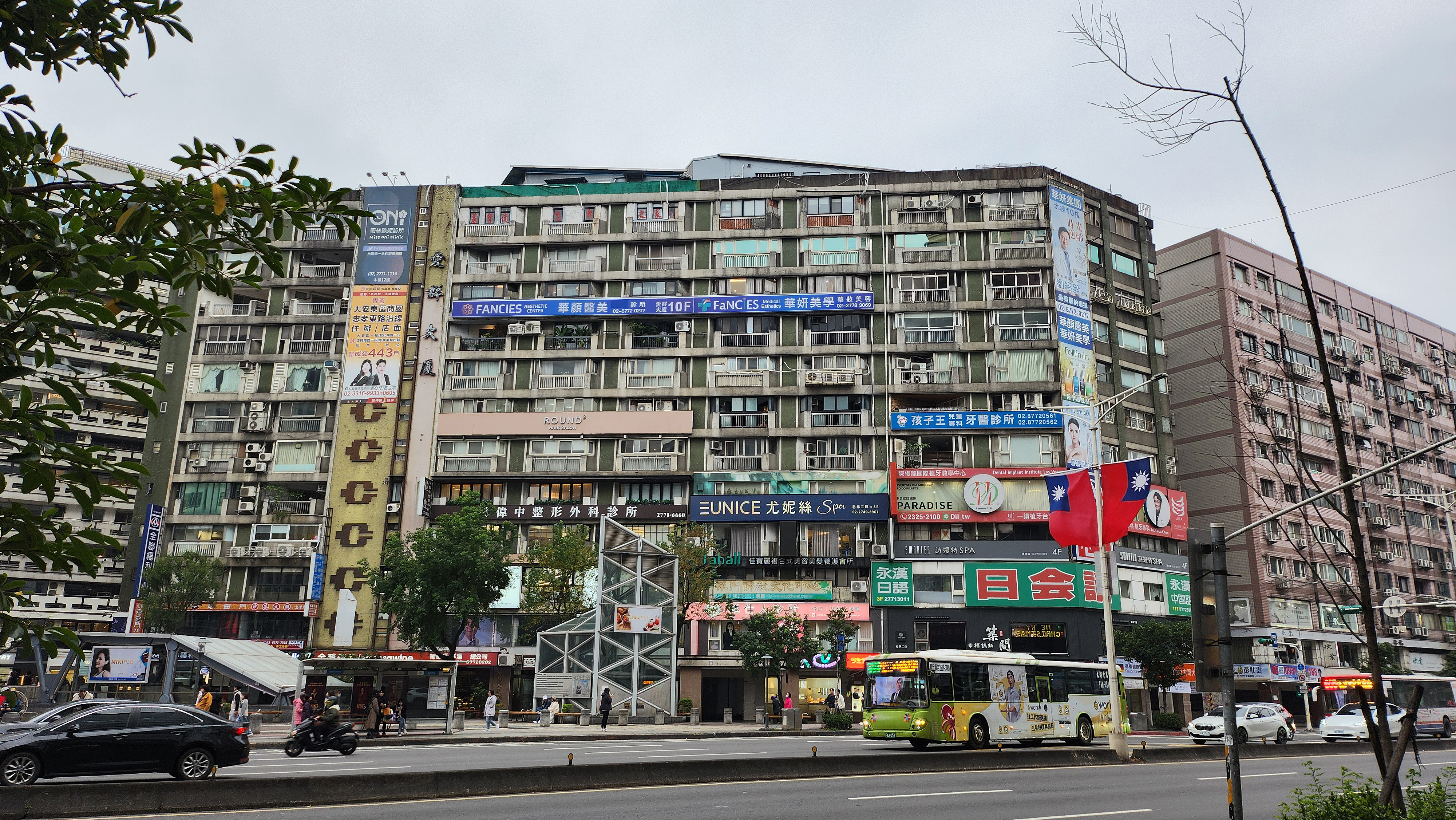
Part of the convenience of not having to go far to get anything you want is driven by the sheer density of cities in Taiwan—most storefronts have residential apartments in the floors above them, which are also built densely. Hair salons, dental clinics, medical clinics, esthetic clinics, after-school classes, foreign-language classes (especially English and Japanese), and other businesses are numerous, making it easy to walk in for, say, a haircut without making an appointment.
Temples are fairly ubiquitous in Taiwan, as folk tradition involves the worship of many deities. Perhaps similar to other places, the degree of true faith varies widely among individuals, but many people go through the motions of rituals on holidays and important occasions. The artwork is stunning, regardless, in its intricacy of detail and vibrancy of color.


Lungshan Temple (龍山寺) is a large temple dedicated to multiple deities, including the goddess of mercy, Guanyin (觀音), and the goddess of the seas, Matzu (媽祖). The roof features sculptures of dragons, phoenixes, and other motifs of legend.

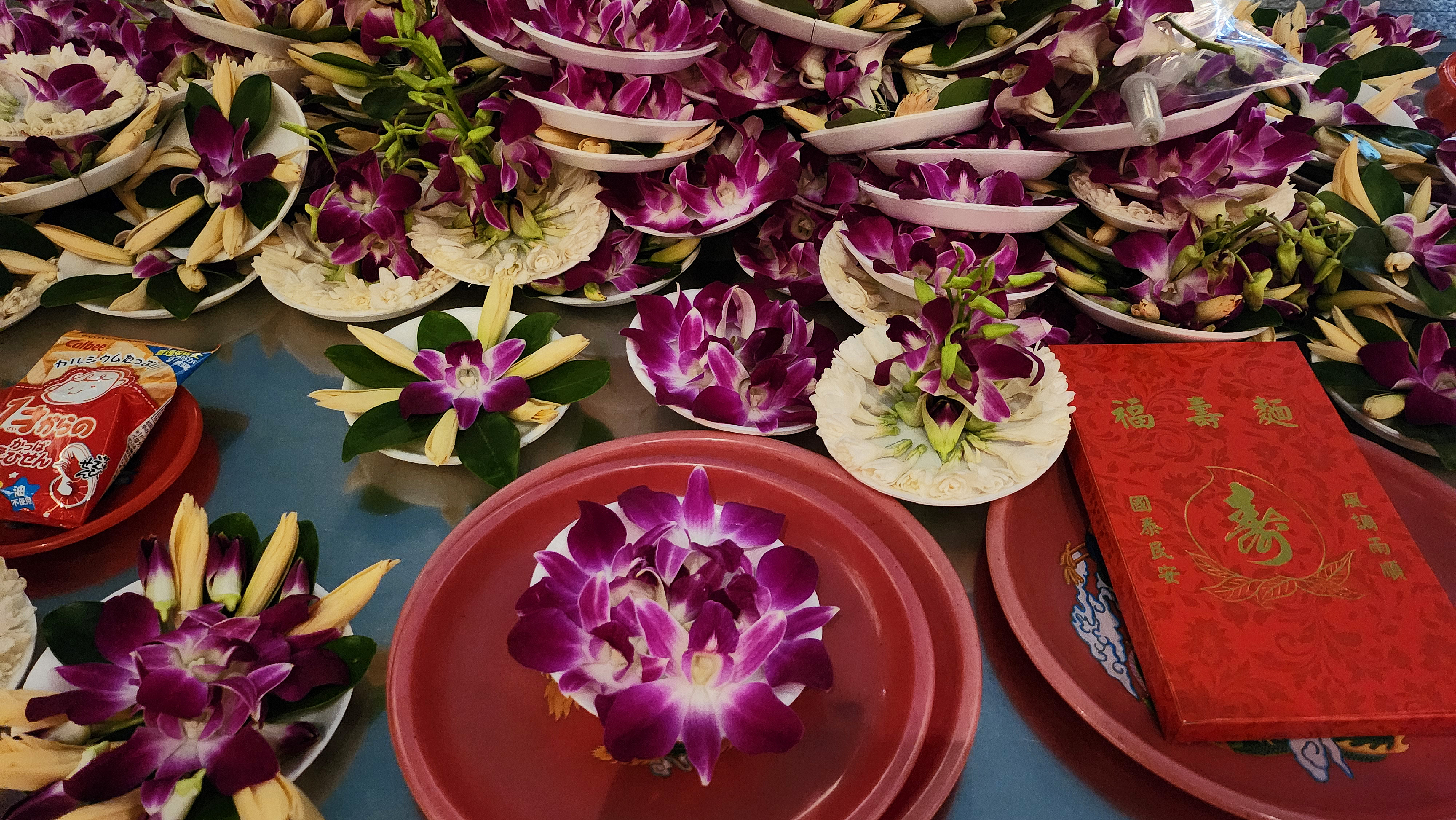
Naturally, the fragrance of incense and smoke pervades temple surroundings, but Lungshan Temple presented another diffusive scent just as heady—that of flowers literally piled up as offerings alongside food products. (Several generations ago, the custom was to cook a feast to offer to the gods and ancestors, and the people would eat it afterwards, but now they just place nonperishable foods in their original packaging on the table. I grew up hearing the joke that the gods had to work harder these days for their meals in the otherworld!)
The temple was also decorated with bouquets, presumably gifted, and the most strongly fragrant flowers in them were lilies. Later, we walked by a small, private shrine on a residential street, and it was also scented with large lilies.

Plant life is abundant on the tropical to subtropical island of Taiwan. Native banyan trees can often be seen, and many are several hundred years old, with aerial roots setting down new trunks.

My childhood friend and I were talking about distinctive plants in Taiwan, and she mentioned these little red flowers that seemed to grow everywhere. I noticed them more after she told me. They appear to be Ixora chinensis, which aren’t fragrant, but are pretty against the greenery of the shrubs.

The flower I remember distinctly from childhood is a big, orange-petaled blossom that grows upward on trees and oozes sticky fluid. I saw what I thought was it in Taichung, but didn’t think to take a picture, and after some research, I’ve concluded that what I saw was most likely the flower of the African tulip tree (火焰木), which blooms in winter. The sticky ones I remember may well be kapok flowers (or “cotton flowers,” 木棉花), which bloom in March and April.
I should mention the Yulan magnolia again, also known as white champaca, white michelia, white orchid, white sandalwood, or white jade orchid, because it is popularly used as a simple air freshener in cars. People string a few flowers together and sell them from the medians of busy roads to drivers through their windows at red lights, or on sidewalks to pedestrians. The petals last one or two days and make any car smell much better, in my opinion—a citrusy, creamy, sweet white floral aroma.
A personal thrill was finally getting to (knowingly) smell osmanthus flowers from the source. We had noticed a light, fruity aroma while walking past some small trees, and I was instantly attracted to it. Sure enough, a sign confirmed that they were indeed Osmanthus fragrans, and I sniffed my heart out… and understood a bit better why many osmanthus perfumes smell more fruity than tea-like or leathery.

 Nose Prose
Those temple rooves make my heart sing. I’m grateful for the food tour too. SE Asian food is a fascination of mine.
Thank you for the ongoing travelogues
LikeLike
They are beautiful, aren’t they? I didn’t really appreciate them when I was younger, but now I marvel at the artistry.
LikeLiked by 1 person
Another brilliant travelogue, Nose Prose! Love the shots! Like Flaconneur, I’d be fascinated by the scent of the temples. I’d also love to experience an osmanthus flower close up.
LikeLike
Thank you, Daniel! Temples are certainly a rich olfactory experience. Based on a quick search, osmanthus flowers are available in Australia, although it may be an excuse to travel!
LikeLiked by 1 person
Yes, so it seems. And they appear to grow in my part of the world in Southern Queensland. Though I suspect they grow best in the cooler southern states of Australia.
LikeLiked by 1 person
Thank you so much for this in-depth tour, Nose Prose. The photos and sheer details were amazing. I might find myself trapped at the temples experiencing the incense, smoke and heady flowers. The food, well, I’ll leave that for the Gods.
LikeLike
So glad you enjoyed it, Flaconneur. I realize I’ve highlighted some of the more shocking foods, but they’re not representative of the wide range of options available for all levels of adventurousness, including zero. Typical flavors include soy sauce, ginger, and pepper, and it’s pretty easy to find restaurants and eateries that cater to Buddhists who follow a vegetarian or vegan diet that excludes alliums (onions, scallions, garlic, chives, and leeks).
LikeLiked by 1 person