Do any of you play the New York Times game Spelling Bee? The idea is to find as many words as possible from a set of 7 unique letters. Each word must be at least 4 letters long and include the center letter. Longer words get more points. If you use all 7 letters, you’ve found the pangram—and, in my case, a dopamine hit. Proper nouns, profanity, and obscure words are excluded from the word list.
Therein lies the rub: the word list is not determined by an electronic dictionary, but rather, a person who curates it based on what they deem appropriate for the majority of the puzzle-solving audience. I have noticed over time that often, some medical or scientific terms (which I don’t think are that uncommon) are excluded, such as “trocar” and “lytic.” On the other hand, words that are really abbreviations are allowed, for example, “anti” and “dino.” And then if you put on your snickering preteen cap to spot permutations of letters like “boob,” “goop,” “poop,” or even “pooh,” you’ve scored a point for each. By now I’ve learned to try everything, as the game has no penalty, and frequently been surprised at what counts as a word.
Guess what doesn’t count? Many plant names, not to mention other perfumery-related terms. Here is yesterday’s Spelling Bee:
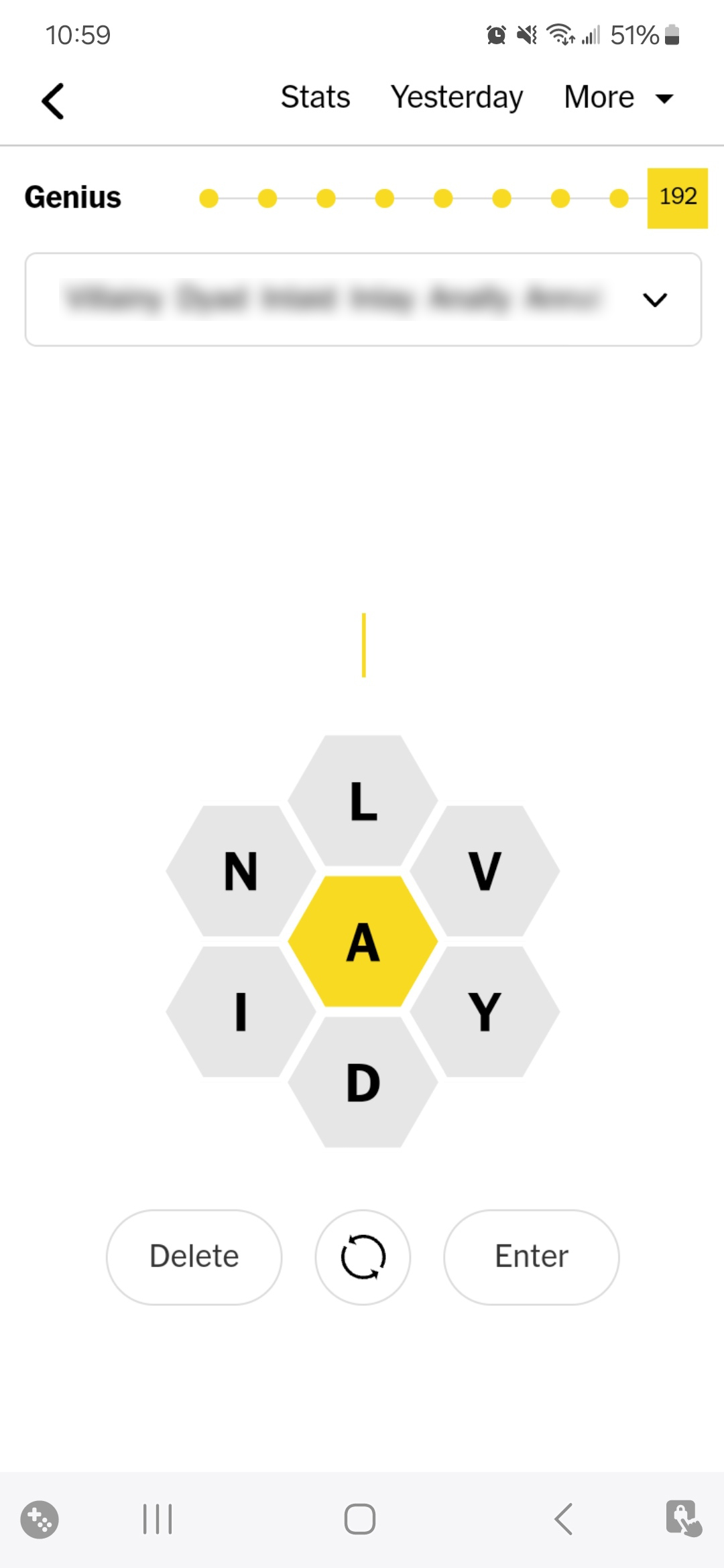
This one contained more perfume words that I found compared with any other iteration so far, but did these make the cut? Nooo…
- Davana
- Lavandin
- Vanillin
Any others I might have missed? (Don’t worry, “vanilla” made it.)
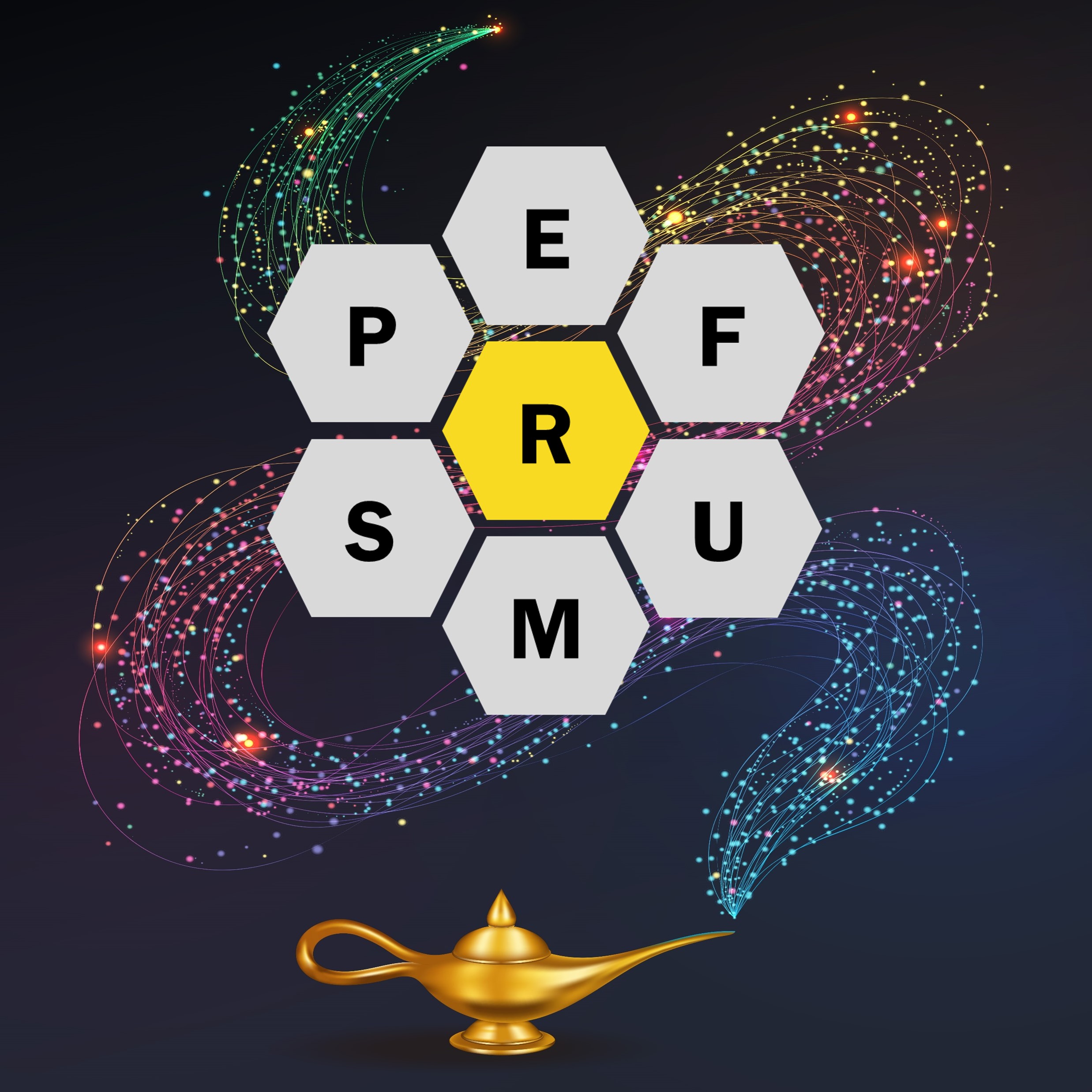
The experience prompted me to indulge in a bit of fantasy. Imagine if our niche were not considered too obscure for the anagram-seeking masses.
Would you be one who errs on the side of being sure before you buy perfumes, or do you prefer to indulge in shopping sprees, especially in the summer and before supper? Are you super susceptible to pressure from sales reps to open your purse for a fragrance that smells like furs that purr, and then refer your peers? Do you wear scent for pure pleasure, and would you ever refuse a free sample out of mere pride? Would knowing that a perfume contained real ambergris from a sperm whale spur a purchase? Could a new discovery ever usurp the place of your favorite?
So far I’ve found 58 words from my own puzzle (ones with the letter “s” are easier like that). “Smurf” is not one of them!
What perfumed this little escapade, you might ask?
I finally opened the discovery set of Mihan Aromatics that I bought in Budapest. They are an Australian brand of scents that “conjure heartache, hubris and harmony” and use a distillation of organic sugarcane as the solvent. The perfume I chose to explore today based on the notes was Petrichor Plains, launched in 2019. I couldn’t find information about the perfumer.
Instead of “fragrance family,” they use the word “cue,” which for this one is “water.” Top notes are iris and rain; middle: violet, rosemary, cardamom; base: amyris, Australian buddhawood. The nozzle wouldn’t spray, so I had to pry open the vial with pliers, and poured the whole 2 mL over myself.
My first impression was “a watery Santal 33,” but that was just my nose trying to find something familiar to anchor. The water effect is really well done, and I’m convinced of most of the listed notes. Together they create a smooth illusion of papyrus and leather, a soft feel. I’m reminded of a temple without the incense. Indeed, buddhawood has such an apt name—it’s clean and slightly smoky, reassuringly solid and mysterious, as though conveying silently that it’s been around far longer than you or me. Drier than sandalwood and darker than hinoki wood, but reminiscent of both.
At the peak of the development of Petrichor Plains, I was transported to a temple after a brief but heavy summer rain. During the time I spent in Taiwan as a child and adolescent, I became very familiar with the scent of Buddhist temples. The strong fragrance of wood and incense would waft outside and in my mind I probably grew to associate it with going out to meet relatives for meals… most likely a consequence of temples being ubiquitous enough to coincide with the vicinity of where we may have been standing around chatting afterward. This could also be a false memory, but it’s what the perfume brought to my mind.
I enjoyed this comforting, yet escapist, scent throughout the day and kind of wish I hadn’t used up my sample all at once, especially now that I’ve learned that all of the Mihan Aromatics perfumes are at 30% concentration! I wouldn’t have guessed that, though, as it feels like a close wear.
Are you familiar with this brand? Do you like fragrances that feature petrichor?


So frustrating when those sprayers don’t work. I’ve tried this one, and it’s a pretty decent approximation of the scent after a thunderstorm. I believe the perfumers for all these Mihan scents are Josh and Julia Mihan (One of the local stockists Lore Perfumery lists them as the perfumers).
LikeLike
It would make sense that the founders are the perfumers; perhaps that is implied on their website, but it wasn’t very clear. They do have a nice story.
LikeLiked by 1 person
Extrait & Parfum concentrations always wear close so maybe that’s why at 30% you found that this did.
Isn’t it annoying when atomisers won’t work
LikeLike
That makes sense, although I’ve also tried some extraits that are so strong that a tiny spray is enough. This one never felt excessive.
LikeLiked by 1 person
Nice post, Nose Prose. I am not familiar with Mihan Aromatics, but I was just reading about founders Julia Brown and Joshua Mihan. They have a very interesting story. This idea of scents of the first rain remind me of my travels in New Mexico here in the U.S. The desert is an interesting place of fragrances, and more so after a rain. I love the scent of rain, sand and Larrea tridentata, or more commonly known as creosote bush. It’s a lovely combination that I wish someone would bottle.
LikeLike
Thanks! I haven’t experienced the desert after a rain, but that sounds like a wonderful scent combination.
LikeLike