Since I was little, I’ve always seen numbers and letters of the English alphabet in colors in my head. It wasn’t interfering, nor am I sure whether it helped me with memorization. It just was, and I didn’t know that not everyone else had the same experience. Eventually I learned the word “synesthesia” and the various forms of it—the term that seemed to fit my way of perception most was “grapheme-color synesthesia.”
Along with the fancy phrase, I discovered a research article about it that made me feel validated in some ways: titled “Grapheme-color synaesthesia is associated with a distinct
cognitive style,” it stated:
The most important result was that those who reported grapheme-color synaesthesia showed higher ratings on the verbal and vivid imagery style dimensions, but not on the visual-spatial style dimension. […] Our results indicate that grapheme-color synaesthetes prefer both a verbal and a specific visual cognitive style. We suggest that this enhanced preference, probably together with the greater ease to switch between a verbal and a vivid visual imagery style, may be related to cognitive advantages associated with grapheme color synaesthesia such as enhanced memory performance and creativity.
—Meier B, Rothen N. Front Psychol. 2013;4:632.
As someone who learns best by reading and struggles with spatial orientation, overly relying on the GPS even in areas where I’ve lived for years, I felt better after reading that.
It’s interesting to note that when I learned other alphabets as an older child, teen, and adult, the color associations were much weaker and usually linked to the same sounds in the English alphabet (and thus triggered by hearing them rather than by seeing the characters).
More recently—I can’t believe it’s been almost a year now!—I encountered a new word via Alityke’s post that might be a more suitable descriptor: ideasthesia. The difference, according to Wikipedia, is that “while synesthesia presumes that both the trigger (inducer) and the resulting experience (concurrent) are of sensory nature, ideasthesia presumes that only the resulting experience is of sensory nature while the trigger is semantic.”

In any case, when I first started exploring perfumery in 2019, I wanted to dedicate a perfume to this phenomenon. I also wanted to play with cade essential oil, because I’d smelled it at my first natural perfumery workshop and the instructor, Cher, had advised me not to include it in my blend as it would take over. So I bought my own and dabbled and found that she was right—it was very overpowering, and did not feel like a representation of synesthesia. I put the project aside to revisit when I gained more skills.
Earlier this year, I found the above image in my files and decided it was time to try again. I had also just purchased several new materials from Fraterworks and was eager to experiment.
This time, I wanted to take it in a much lighter direction, starting with geosmin. The molecule responsible for the universally recognizable scent of petrichor, or earth after a rain, is one that I’ve only gotten to know fairly recently. I find it very surrounding, encompassing not only the smell but the feeling of that environment. (It also smells of the earthiness of beets. The other day, I took a bite of roasted beet and felt as though I’d inhaled a mouthful of geosmin!)
I also wanted it to be fizzy, as that is another sensation beyond scent. Naturally, an aldehyde.
The other ingredients I wanted to explore related more to food. Cardamom essential oil, which I was smelling for the first time after having made self-contradictory comments over the years about the note in various perfumes, was counterintuitively warm to my nose. Filbertone, a molecule present in hazelnuts and chocolate, smelled just like fresh, raw hazelnuts.
Of course I had to include Fleur de Cuir, after raving about this natural co-distillation of osmanthus into cedarwood, with its floral, animalic, and leathery facets. The base Gardenia J. Ellis was so moreish in its creamy floralcy and hint of milky biscuits that I added it to the mix, along with some orris root tincture to ground and smooth things out.
Shiso essential oil was an old favorite raw material that felt right to revisit as well. It’s a scent that I first got to know by taste as a child in Taiwan, often used to augment the flavor of pickled plums. Shiso-plum hard candy was also a treat. Later, I discovered its role in enhancing sushi. Shiso is a green leaf that smells very pink to me.
The first several attempts were a lesson in how much of each material is a reasonable amount in a blend. Cardamom was much stronger than I’d anticipated, and eventually I diluted it to 0.2% in alcohol. Shiso I’d played with before, but this time I found that it also could be very dominating. It needs to be dosed right to avoid a bitter undertone. I found it manageable at 10% dilution.
The ingredients were disparate and needed some bridging, so I added some old friends, cassis base 345B (which also smells pink to me) and the mild woody-amber Ysamber K. After more mods, I realized—much to my disappointment—that Fleur de Cuir was clashing with the greener facets of the blend, so I finally took it out.
Something was dense and chalky, which I didn’t like, so I removed the orris… and after a few more tries, the Filbertone as well.
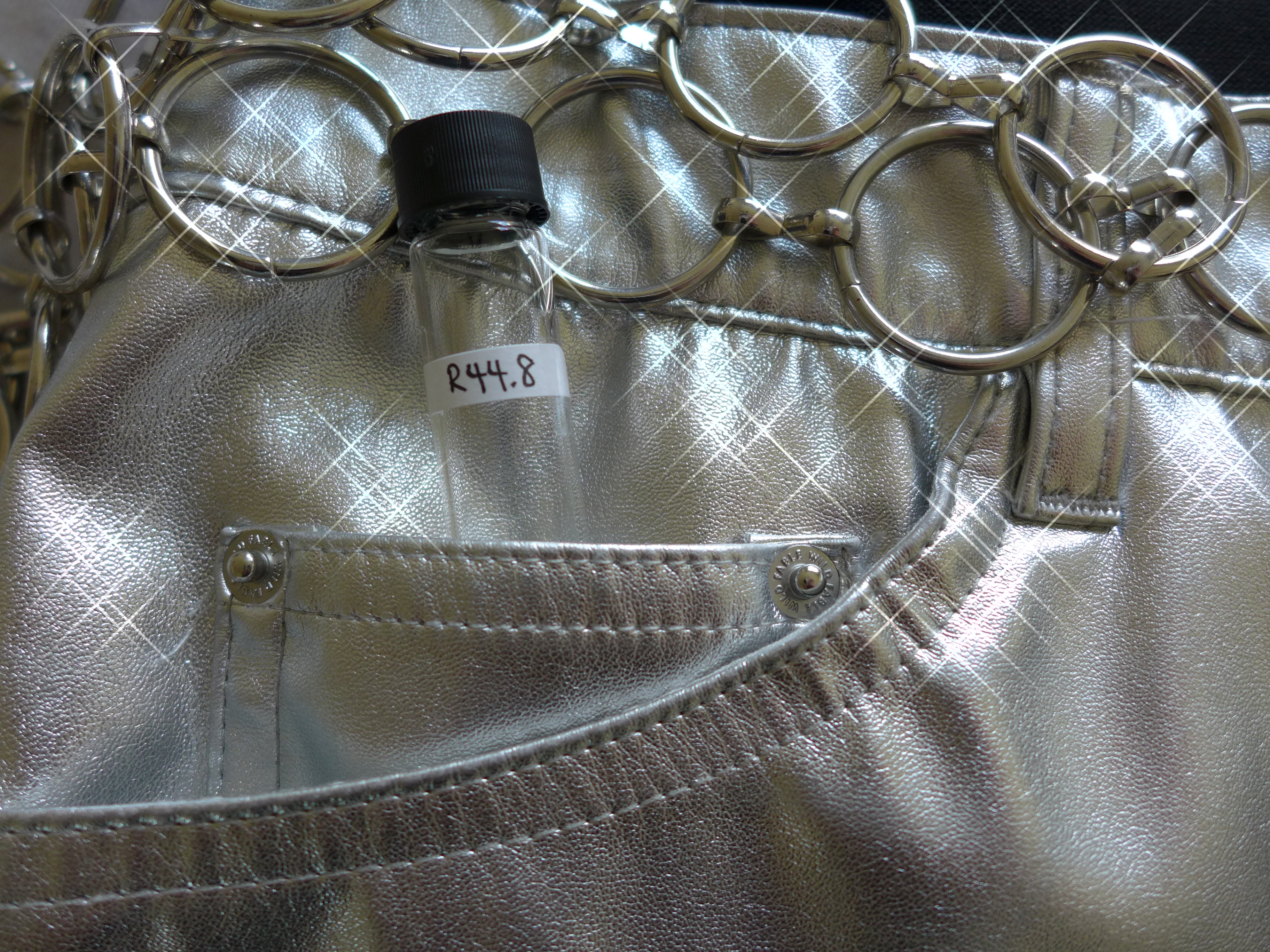
Finally, the proportions are starting to make more sense. The main scent is shiso paired with cassis, a duo that reminds me of the nostalgic shiso-plum candy. I get the overall effect of geosmin, and though I don’t perceive the aldehyde fizziness as I would like, my other half says he does. Other ingredients stay in the background as supporting players.
- Key materials: shiso essential oil, cassis base 345B, geosmin, aldehyde C12 MNA
- Supporting materials: cardamom essential oil, Gardenia J. Ellis
- Structural materials: Paradise Molecule (a diffusive booster like Hedione), Rhubofix, Edenolide, Ysamber K
It’s fleeting, like the perception of colors with words. There’s still plenty of space to be filled in this tiny universe in a vial.
 Nose Prose
I’m so happy my piece inspired you to further explore R44.8 & ideasthesia further.
You have such academic discipline in exploring, creating, assessing & modulating. Yet you do it for the pure joy of it. So creative! Brava
LikeLike
Thank you! It’s mostly trial and error. I’m glad it’s a hobby and not a job. Writing about something is as much joy as making it!
LikeLiked by 1 person
Great to read about your “grapheme-color synesthesia” and that these things are increasingly understood. R44.8 sounds like a wonderful work in progress. And all those ingredients in the composition are absolutely fascinating!
LikeLike
The ingredients are each great on their own—they need to be held together better in ways yet unknown to me. 😉
LikeLiked by 1 person
I love reading about these crossover sensory phenomena. I recall reading an article years ago that Frederic Malle uses synesthesia to create perfumes with his perfumers. So rather than talk in technical chemical terms he asks the perfumer to make the perfume greener, yellow or more purple. Your perfume sounds very nice, Nose Prose.
LikeLike
I think most of us reference other senses when we talk about perfume to some extent. When I first got to know the brand Frédéric Malle, they were promoting the limited-edition “synesthesia” bottles decorated with resin in different colors to express each fragrance. I wasn’t ready for a full bottle at that time.
LikeLike