They say nature abhors a vacuum. Now that I’m satisfied with the perfumes I have, not wanting to buy more, and having let go of some that didn’t really make me happy… my subconscious seems to interpret that as having room to explore again. I’ve become suggestible in unexpected ways recently, via memory anchors I didn’t know had formed.
That said, my threshold for wanting to try new fragrances has been raised considerably. A lot of brand collections feel similar, with one representative from each fragrance family, or built around familiar themes of travel, amorous encounters, personalities, history… and it doesn’t help that they’ve gotten much more expensive in the last few years. The ones that pique my curiosity recently are ones that have had time to macerate in the mental vault.
For instance, when Portia mentioned Olympic Orchids recently, I immediately remembered that on my trip to Taiwan in 2024, I had been shown this brand in a niche perfumery when I specifically asked about Olibanum because I’d read about it. As I’ve grown fond of frankincense as a note in recent years, I went ahead and bought a discovery set. (It’s one of the more reasonably priced ones.)
Soon after that, Flaconneur included Régime des Fleurs in a list of new releases, and I recalled that on a visit to Dover Street Parfums Market in Paris (also in 2024), I had smelled Leather Petals from this brand and thought to myself, “I could wear this,” but did not pursue it as I already have enough leather fragrances. That sent me on an impulsive hunt for a sample, and it would appear that I’m late to the game, because that perfume is no longer on the brand’s website. It’s still available from some stores, and after browsing the entire catalog of discovery sets from one, I bought only a tin of rose tea in addition to the singular sample.
If there’s a theme that I’m drawn to more than others, it’s raw materials or notes. These are less subjective, and I’m usually more likely to find several that I like from a collection. Atelier Materi, Maison Crivelli, and Le Labo (despite the notorious bait-and-switch in their naming) are all solid examples of this. To build an entire brand based on one ingredient, however, strikes me as bold and intriguing.
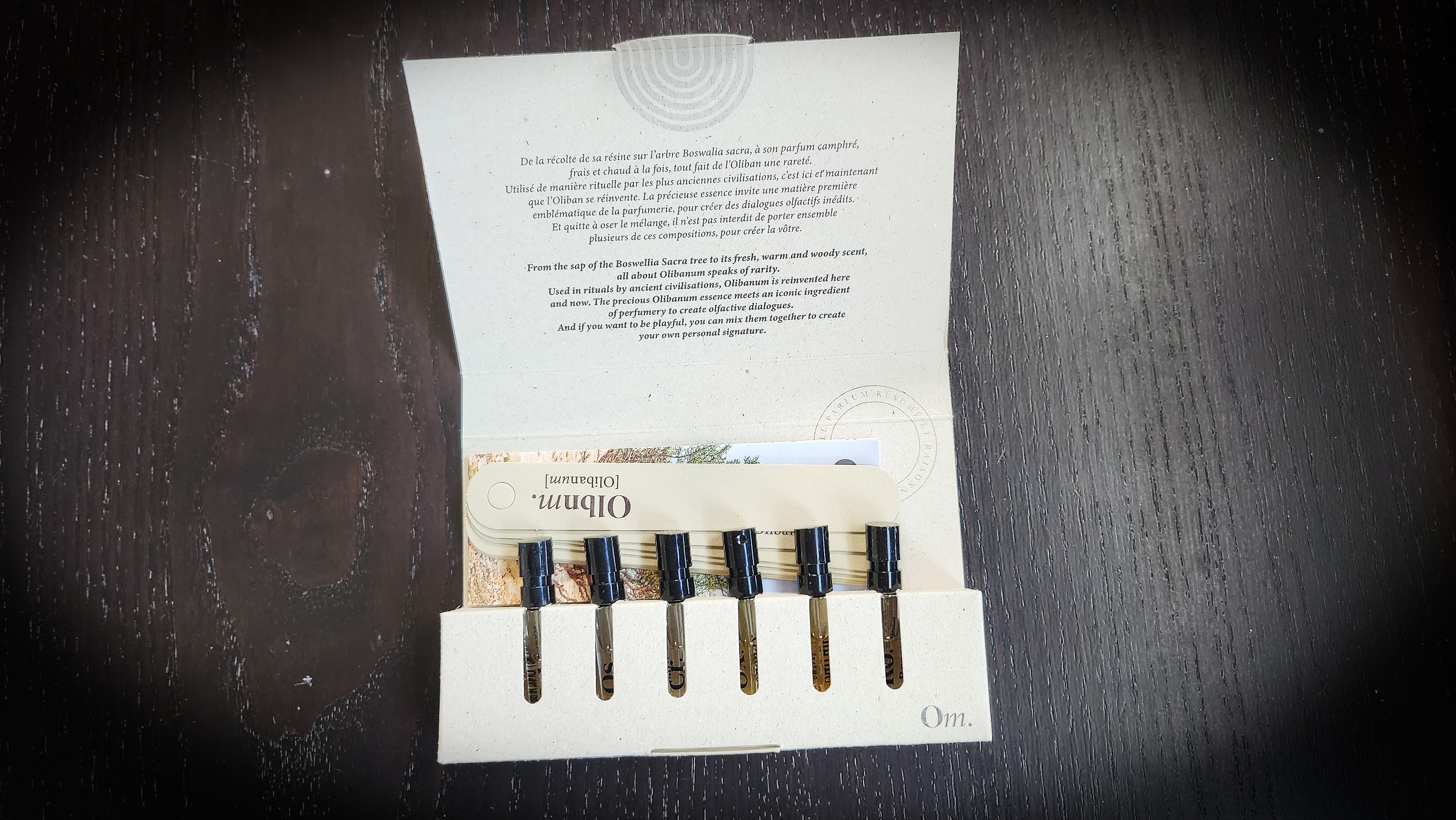
Olibanum (or Olbnm, or Om.), founded by perfumer Gérald Ghislain, places great emphasis on sustainability and making a positive impact, and the execution is apparent from the minimal packaging using recycled cardboard. Instead of having a fixed set of samples, you choose your own six. All contain a CO2 extracted olibanum from Somalia, per the website. Unfortunately Sacra, the “original” frankincense with fir balsam, was not available to sample. My selection in alphabetical order: Cuir végétal (Cr.), Opoponax (Ox.), Osmanthus (Os.), Oud (Od.), Rose (Ro.), and Safran (Sf.).
These fragrances are designed to be layered, and the principle is similar to others’—pair X with Y to darken it or with Z to lighten it. I remember having my mind blown when I first saw a Jo Malone display with this kind of instructions, what feels like a lifetime ago. Funny story: when I first discovered Le Labo, I thought their offerings were intended to be layered as well. I might even have said so out loud. It wasn’t until later that I learned about brands using signature bases in their perfumes.
The Olibanum sample I picked out today without reading the label first was Opoponax (Ox.). This resin is also known as sweet myrrh; in this rendition, it is indeed warm and sweet, even chocolatey in the opening. The brand leaflet states:
An ambery Opoponax brimming with cistus and tonka bean. To wear during a heatwave, when the desert sand clings to your skin.
The joke’s on you, Opoponax! We had giant snowflakes this morning in my corner of the northeastern United States! (Actually, the joke’s on me because I’m having winter in April…)
The cold doesn’t seem to do the scent disservice, though, as the resins are generous with their warmth. I don’t smell the olibanum note very noticeably, but I sense it balancing the composition with lightness. Somehow I’m reminded of Floraïku Between Two Trees, which lists notes of grapefruit, mate, and vetiver. My guess is that the smoky yet round aspect of Opoponax resembles the effect of vetiver. This brings me back to my earlier days of perfume exploration, and that’s a good feeling.
Opoponax neither projects strongly nor overtakes other scents, unlike Safran, which I happened to spray on my wrist out of curiosity—before I saw that the leaflet encourages this pairing (“Use Opoponax‘s spicy streams to awaken Safran“). That one spritz of Safran lasted most of the day, a harsh, metallic note detracting from my cocoon of Opoponax. (Thankfully, it dries down to a calm vanilla later.)
Have you tried Olibanum fragrances? Do you have a favorite perfume featuring frankincense? How are your ups and downs with curiosity toward new perfumes?


Oh yes, we love Frankincense perfumes. That and vetiver we think are our favorite scent profiles: Incense 01, Encre Noir, Red Flag… all stunning in their own rite (pun intended). I think more houses are using discovery kits as studies in how a single ingredient can change an entire composition. For instance, Molecules has a discovery set that uses Iso E Super as the base and then adds one ingredient: patchouli, balck tea, ginger, etc. We almost bought it the other day, but opted for breadth instead and went with 20 Etat Libre d’Orange.
LikeLike
Happy to meet a new fellow fragrance enthusiast and to read your blog as well! I think the Etat Libre d’Orange discovery set is a great choice as it offers so many perfumes for relatively good value. I bought it a few years ago and liked several, with Remarkable People being my favorite, especially in the opening with its sparkly champagne note. Curious what your favorite(s) will turn out to be.
LikeLiked by 1 person
Ha! Thanks for visiting. I will definitely let you know. Takes me time to work through a set. I like to wear something different every day.
I look forward to reading more of your writing, and some of the others who’ve left comments here. So good to find so many like minds in one space.
LikeLiked by 1 person
I haven’t tried the brand, unfortunately. One of my favourites would have to be Comme des Garçons Avignon. I try to remain curious about this fragrance world of ours, but sometimes all the churn can make that seem impossible, but there’s always something new or old of value to discover, ultimately. Great post!
LikeLike
Another vote for Avignon – now it goes even higher on my list to try! Luckily, there isn’t really a time limit for discovery, so we can go at our own pace.
LikeLike
Love this idea of transforming a single note into completely different fragrances Nose Prose. Doing it with olibanum makes it even more desirable to try.
Thanks,
Portia x
LikeLike
Yes, it’s versatile enough to work in different directions.
LikeLiked by 1 person
I understand the need to explore. However, I have never had the urge to explore single notes. I don’t want to see behind the curtain, it’s the magic of brilliant compositions I adore.
Churchy frankincense gives me a banging headache, hence I like it as part of an orchestra rather than the lead. The early Amouages, with their use of Omani silver frankincense are the pinnacle of incense use in fragrances
LikeLike
I appreciate the magic as well, and enjoyed the frankincense in some of the Amouage extraits, particularly Epic 56 Woman. Even with perfumes featuring specific notes, they usually do something interesting around it such that it’s not like just smelling the material.
LikeLike
Ha. I like your thinking process, Nose Prose. I think we are all naturally curious, and eventually find our way back to discovering new scents at some point. I love the macerate line as well. This collection sounds intriguing. As far as frankincense scents go I find CDG Avignon and Heeley Cardinal hard to go past. But, Basilica from Milano Fragranze is more interesting as it pairs the smoky notes with herbal and creamy notes.
LikeLike
I think you’re right, Daniel. I’ve heard of all three of these but not tried them; with your mention of them here, I’ll probably be more likely to when I see them next time!
LikeLiked by 1 person
II’m happy to be a catalyst, Nose Prose. I thoroughly enjoyed the analogy “macerate in the mental vault.”
Olibanum Gardenia by Bohoboco is a favorite of mine, and it might seem quite obvious by name. It’s a beautiful smoky gardenia that starts bright and gradually deepens into a warm and cozy scent. The fragrance features a heart of frankincense and a base of Olibanum wood. It’s simply lovely!
As far as frankincense perfumes go, I’m very fond of Sahara Noir by Tom Ford, Agneta by Eight & Bob, Oliban by Grisens, Encens Copal by Jacques Fath and Opus IV by Amouage.
LikeLike
Thanks, Flaconneur, and you certainly are a catalyst!
Olibanum Gardenia sounds gorgeous.
LikeLiked by 2 people
If you get the chance, it’s worth trying. In fact, many of the Bohoboco line are equally intriguing. Plum Spray Paint and Mango Yuzu Gasoline are two of their latest releases.
LikeLiked by 1 person
We love Incense. We need to write these down.
LikeLike
I also wanted to come back here because I was very close to buying a Molecules set today. They have a discovery set that uses the molecules Iso E Super, and essentially they are doing with that what Olibanum. I only just learned about this molecule and how it’s likely in a TON of fragrances alredy sitting on our shelves. I am still more interested in breadth rather than depth, but I might have to break down next time and get it.
LikeLike
Hopefully you can try some of the Molecules fragrances in a store instead of buying a set. There’s also an interesting interview with perfumer Geza Schoen on Persolaise’s YouTube channel, where he explains how not everything goes well with Iso Gamma Super, though many natural materials do.
LikeLiked by 1 person
Nice! Thanks for the reference. I will definitely check the out. The five piece discovery set is reasonable. And, even if they are not all homeruns, something like that will be a valuable learning experience in terms of how different essences play off each other. Likely worth the investment.
LikeLiked by 1 person